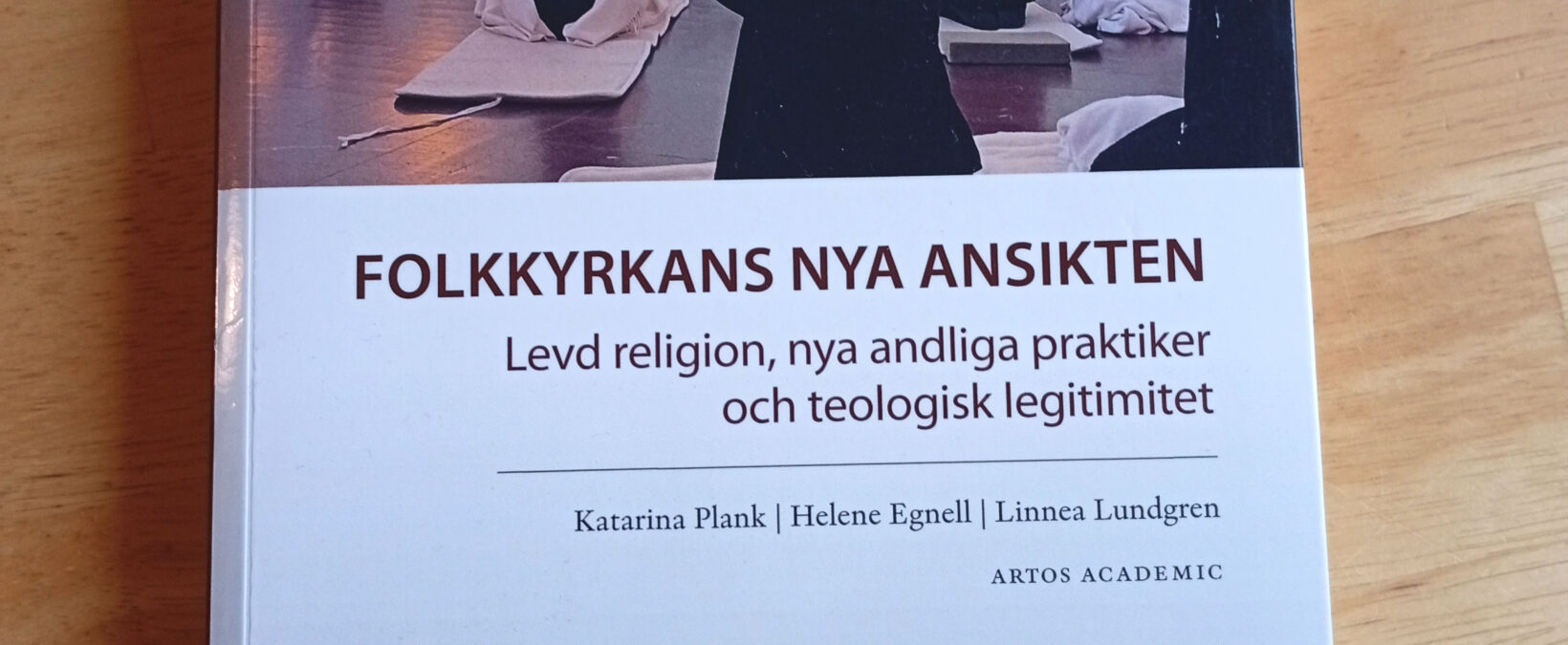
Folkkyrkans nya ansikten. Levd religion, nya andliga praktiker och teologisk legitimitet. 2026. Artosacademic. Katarina Plank, Helene Egnell och Linnea Lundgren.
The book Folkkyrkans nya ansikten. Levd religion, nya andliga praktiker och teologisk legitimitet (New Faces
of the Folk Church: Lived Religion, New Spiritual Practices and Theological Legitimacy) is based on the
findings of a research project of the same name. The project, funded by the foundation Riksbankens
Jubileumsfond, investigated how new spiritual practices, such as meditation, yoga and spiritual dance, have
become part of the range of activities offered by the Church of Sweden. Neither yoga nor meditation is
inherently “new,” but both are new within ecclesiastical contexts. The initial survey conducted as part of the
project showed that these practices are now widespread in the Diocese of Stockholm. At present, as many
as eight out of ten parishes offer new spiritual practices. The book consists of nine parts in which the
authors not only discuss the findings, but also describe the research process and the various stages of the
project.
The authors bring interdisciplinary expertise to the subject. Project leader Katarina Plank has extensive
experience in using ethnographic methods to study contemporary religions and Eastern practices. Helene
Egnell contributes theological expertise through her work as a priest in the Church of Sweden. Linnea
Lundgren’s background is in the sociology of religion and civil societal research.
Practices such as yoga have traditionally been associated either with secular wellness culture or with New
Age spirituality and Eastern-inspired spiritual traditions. Over the past few decades, however, these
practices have also entered church spaces, where they can be reinterpreted and framed within a Christian
context. Generally speaking, these are practices dominated by women, focusing on stillness, well-being,
healing and existential depth. When the range of activities taking place in church spaces expands to include
new practices that have not traditionally been part of the Church’s repertoire, questions arise about what
these practices actually mean to participants and how they are theologically legitimized. The project
explored these questions through ethnographic fieldwork and interviews with both participants and
leaders.
The theoretical approaches presented in the book are based on the concepts of lived religion, religious
intertwining and the immanent turn. Drawing on rich ethnographic material, the book demonstrates how
different practices become intertwined with Christian vocabulary, and how participation in these activities
acquires religious, social, pastoral and physical well-being-related meanings and functions.
The immanent turn can be observed in the religiosity of the Church of Sweden in the growing tendency for
religious experiences to be encountered in bodily, material and everyday contexts. Protestant religiosity,
which has traditionally focused on intellectual dimensions, has expanded its forms of expression by
incorporating bodily activities and experience-based expressions of faith.
Tommy Ramstedt, PhD, researcher Study of Religions, Åbo Akademi University