
Library
The largest special library on religion in the Nordic countries
The Donner Library opened as long ago as 1957 and is today the largest specialist library on religion in the Nordic countries. The library’s collection is stored in Åbo Akademi Library’s remote storage facility, Rix, and the collection is accessible via the Alma-Finna database. Ordered books can be picked up from ÅAB’s premises in Arken (Tehtaankatu 2), open Monday–Friday from 10:00 to 18:00. Our primary customers are students and researchers of religion, but our library is also open to the general public.
Our collection comprises approximately 90 000 volumes pertaining to research on religion in a broad perspective. The central journals within the field are available in printed form in the library and we can help you to find your way among the e-publications as well.
Book of the month
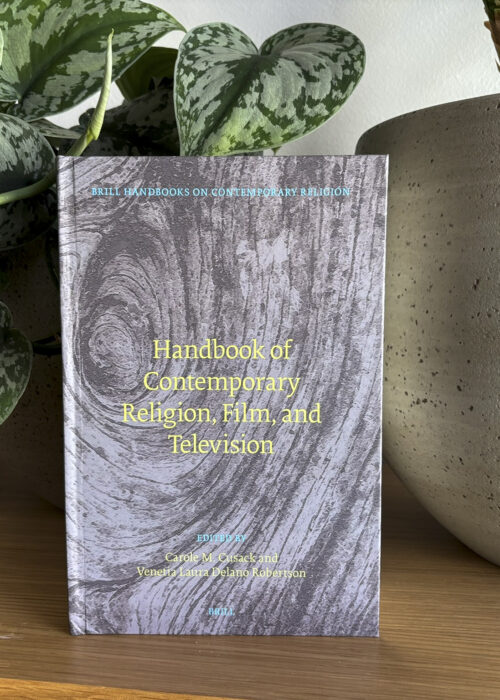
Handbook of Contemporary Religion, Film, and Television. 2026. Carole M. Cusack and Venetia Laura Delano Robertson (eds.), Brill.
Since the turn of the millennium, research on religion and popular culture has grown from a relatively marginal area of inquiry into a broad field with its own journals, handbooks, and recurring conferences. Within this field, some subareas have attracted more scholarly attention than others. While research on religion and film is extensive, studies of religion and television remain somewhat more limited. At the same time, these two areas share many points of convergence, making the decision to publish a handbook addressing both from a contemporary perspective understandable.
How, then, should one present research on religion, film, and television, a field that is by its nature very broad? Existing handbooks in the study of religion and popular culture have naturally adopted different approaches. Topics may be examined from historical perspectives, tracing, for example, the intersections of religion and film throughout the history of cinema. Thematic and theoretical approaches are also possible, and it is equally common to focus on different religious traditions and the ways in which they have been represented in popular culture.
In Handbook of Contemporary Religion, Film, and Television, the editors have chosen to organize the chapters according to genre. At the same time, they aim to provide as multifaceted a perspective as possible, encompassing films from diverse regions of the world and employing a variety of theoretical approaches. The result is a complex and rich collection. For instance, the first section, devoted to drama, romance, and comedy, includes, among other topics, a historical study of Judaism in film and television, analyses of clergy in British television, discussions of religious characters in Nordic cinema, and explorations of inter-faith in Malaysian film.
As the editors acknowledge in the handbook’s introductory chapter, the volume does not succeed in covering all religious traditions of interest or film from all parts of the world. Nevertheless, the volume is a thought-provoking collection of studies that engages with ongoing methodological and theoretical debates and demonstrates the need for diverse perspectives and approaches in the study of religion, film, and television.